888-871-6573
Call Toll Free

Call Toll Free
Call Toll Free
Stainless steel banding for hvac installation: Learn how to install stainless steel banding for HVAC systems. Step-by-step guide covering tools.
Last Updated: September 27, 2026
Before you pick up a tool or unroll a single strap, gather the essentials. Proper preparation cuts installation time in half and prevents costly mistakes on site.
You’ll need stainless steel banding in the correct gauge and width for your application, a tensioning tool designed for the grade you’re using, and buckles or clips rated for your load. A measuring tape, marker, and safety glasses are non-negotiable. For fire-rated or high-temperature applications, confirm your banding meets the thermal requirements of the space.
Having the right tools paired correctly prevents the preload loss that causes failures under vibration. Most crews underestimate how much a mismatched tool costs in rework.
Not all stainless steel is the same. The grade you choose determines how long your installation holds under temperature swings, humidity, and vibration.
Grade 201 vs 304 vs 316: Which Works for Your Project
Grade 201 stainless steel is the entry-level choice. It costs less and handles general HVAC ductwork in dry indoor environments. However, it has lower corrosion resistance than higher grades and can develop surface rust if exposed to salt air or high humidity. Use it for standard commercial HVAC in controlled buildings.
Grade 304 is the workhorse. It resists corrosion far better than 201 and handles variable humidity, outdoor installations, and light industrial environments. Most HVAC contractors reach for 304 because it balances cost and durability. It’s the standard for ductwork that sees seasonal temperature swings.
Grade 316 stainless steel banding for hvac installation is the premium option. It contains molybdenum, which provides superior resistance to chloride corrosion. Specify 316 for coastal installations, marine facilities, or any application where salt exposure is a factor. It costs more upfront but eliminates the risk of corrosion failure in harsh environments.
The real difference comes down to your environment. A facility 50 kilometres inland in a temperate climate? Grade 304 handles it. Coastal operations or mining sites with chemical exposure? Grade 316 prevents the preload loss that happens when fasteners corrode. Band-N-Go stocks a wide range of banding widths, thicknesses, and coatings, so you’re not guessing whether your tool works with your material.
Width and thickness aren’t cosmetic choices. They determine how much load the strap can handle and whether it distributes pressure evenly across your ductwork or insulation.
Standard widths range from 12 millimetres to 50 millimetres. Narrow straps (12-19 millimetres) work for light insulation wraps and cable management. Medium straps (25-32 millimetres) are the standard for HVAC ductwork and most industrial applications. Wide straps (38-50 millimetres) distribute load across larger surfaces and handle heavy pipe systems or vibration-prone environments.
Thickness, measured in gauge or millimetres, controls tensile strength. Thinner banding (0.8-1.0 millimetres) suits light-duty applications. Standard thickness (1.2-1.5 millimetres) is the industry default for HVAC ductwork because it balances strength and ease of installation. Heavy-duty thickness (2.0 millimetres or more) is essential for vibration-prone equipment, mining operations, and high-pressure systems.
The rule is simple: wider and thicker means higher load capacity but also harder to tension by hand. Match your banding to the actual load, not the worst-case scenario. Over-specifying adds cost and installation time without benefit. Under-specifying is the mistake that causes failures.
Band-N-Go offers custom sizes and packaging, so you’re not buying standard widths that don’t fit your project.
The installation process is straightforward if you follow the sequence. Most failures happen because crews skip steps or rush the tensioning phase.
Measuring and positioning the strap
Start by measuring the circumference of your ductwork or pipe. Add 50 millimetres for overlap at the buckle. Mark the position on the duct with a marker, typically every 600-900 millimetres for standard HVAC ductwork, closer for high-vibration environments.
Position the strap so it sits flat against the surface without twisting. Twisted straps don’t tension evenly and create weak points. For insulated ductwork, position the strap over the insulation, not directly on the metal. This prevents the strap from cutting into the wrap under tension.
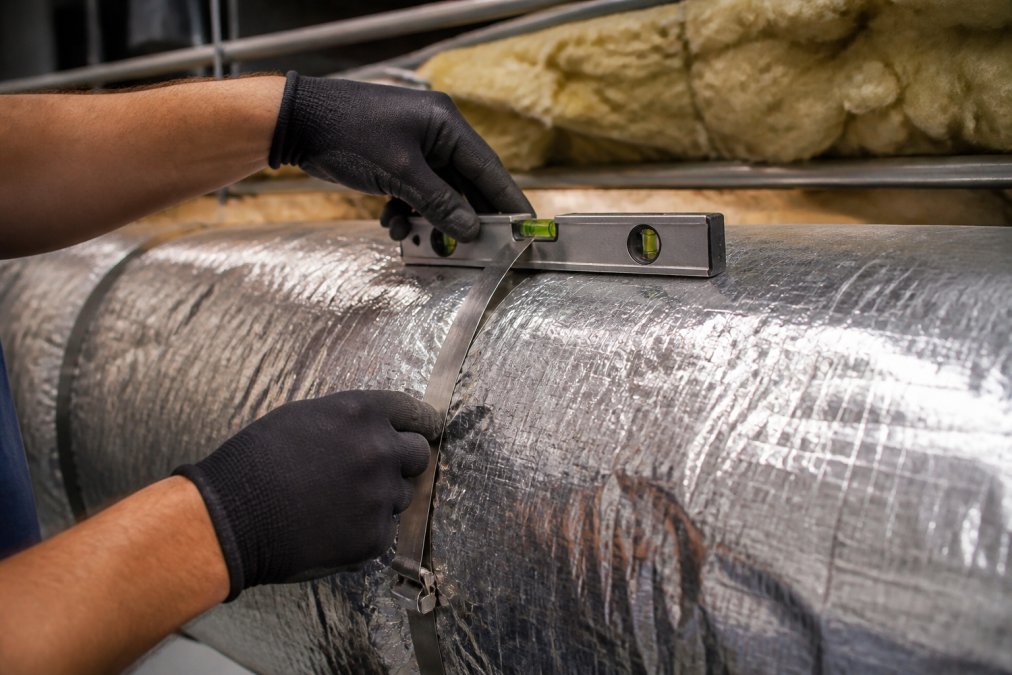
Applying and tensioning the band
Thread the strap through the buckle, leaving enough tail to overlap by at least 50 millimetres. Insert the tail back through the buckle slot, this creates the locking mechanism. Do not skip this step. A strap threaded only once will slip under vibration.
Attach your tensioning tool to the tail end. Apply steady pressure, watching the strap tighten evenly around the ductwork. The goal is snug contact without deforming the duct or crushing the insulation. You should not be able to slide a finger under the strap, but you also should not see the insulation compress.
Tension too tight causes two problems: the strap can cut into insulation or metal under thermal expansion, and the tool can over-harden the stainless steel, making it brittle. Tension too loose and vibration works the strap loose within weeks. Consistent, moderate tension is the target.
Securing the buckle and trimming excess
Once tensioned, fold the tail back and crimp it through the buckle using your tensioning tool or a separate crimping tool. A proper crimp locks the strap permanently. A loose crimp will fail.
Trim the excess tail with tin snips or a specialized strap cutter. Leave 10-12 millimetres of tail beyond the crimp to prevent it from slipping back through. Sharp edges on the trimmed end can catch on gloves or clothing, so file or fold the edge back if it’s in a high-traffic area.
Inspect the installation. The strap should sit flat, the buckle should not rotate, and the duct should not show deformation marks. If the strap is twisted, the buckle is loose, or the duct is dented, remove it and redo the installation. It takes five minutes now instead of a service call later.
Your tensioning tool is only as good as your technique. A tool in poor condition or used incorrectly causes preload loss and inconsistent tension across your installation.
Inspect your tensioning tool before each job. Check for bent or damaged teeth that won’t grip the strap evenly. Clean any corrosion or debris from the tool, a dirty tool slips on the strap and causes uneven tension. If the tool feels loose or rattles, it needs calibration or replacement.
Hand tools require proper grip and steady pressure. Position the tool at a right angle to the strap, not at an angle. Apply force smoothly, not in jerky motions. Jerky application causes the strap to slip or kink. Most crews that report “strap failures” are actually experiencing tool-related failures, inconsistent tension from poor technique.
Pneumatic and electric tensioning tools are more consistent but require maintenance. Check air pressure or battery charge before starting. A tool running low on power won’t reach full tension, and you’ll discover the problem when the strap comes loose weeks later.
Securing insulation to ductwork requires a different approach than securing ductwork to structure. Insulation is compressible, and over-tensioning crushes it, reducing its R-value.
Spacing and load distribution
Standard spacing for HVAC ductwork is 600-900 millimetres between straps.
Fire-rated and high-temperature applications
Most failures fall into predictable categories. Knowing what goes wrong helps you prevent it.
Building codes and safety standards govern stainless steel banding for hvac installation in commercial and industrial settings. Non-compliance can result in failed inspections, project delays, or liability issues.
Stainless steel banding offers superior tensile strength and corrosion resistance compared to standard cable ties, making it essential for air-handling spaces and outdoor HVAC installations. Banding distributes clamping force across a wider surface area, reducing pressure points and preventing damage to insulation. For vibration-prone environments, stainless steel banding maintains preload better than plastic ties, which can loosen over time. The rounded edges and mechanical fastening system also reduce the risk of cutting through duct wrap or fire-rated insulation.
Proper tensioning requires using a calibrated tensioning tool designed for your banding width and gauge. Apply tension gradually until the strap sits snugly without gaps, then secure the buckle firmly. The band should be tight enough to prevent movement under vibration but not so tight that it deforms the ductwork or crushes insulation. For fire-rated wraps, follow the wrap manufacturer’s specifications for tension. Over-tensioning can cause galvanic corrosion at contact points and reduce the lifespan of your installation.
Grade 304 stainless steel banding offers excellent corrosion resistance for most outdoor HVAC installations, with high tensile strength and durability in varying weather conditions. Grade 316 provides enhanced resistance in saltwater or chemically aggressive environments. Neither grade requires protective coatings for standard outdoor use, though proper installation, avoiding galvanic corrosion by using compatible fasteners and buckles, extends service life significantly. Thermal expansion in outdoor applications is managed through spacing guidelines and flexible tensioning practices.
Banding thickness depends on ductwork diameter, vibration levels, and insulation weight. Industrial applications with high vibration benefit from thicker banding to prevent preload loss. Consult your insulation and ductwork specifications or contact Band-N-Go for a custom recommendation based on your project demands.
Securing HVAC ductwork and insulation correctly the first time saves money and prevents service callbacks. The right stainless steel banding for hvac installation, matched with proper technique and consistent tensioning, holds reliably under pressure, vibration, and temperature swings. Band-N-Go provides the banding, tools, and technical support to get your installation right. Get your free quote today and let us help you choose the exact specifications your project needs.