888-871-6573
Call Toll Free

Call Toll Free
Call Toll Free
Industrial fastening tools for contractors: compare powder-actuated, pneumatic, and gas-actuated systems. Learn safety, maintenance, and TCO. Get.
Last Updated: September 28, 2026
Industrial fastening tools are essential for construction, manufacturing, and infrastructure projects, the difference between installations that last decades and those that fail under pressure, vibration, or corrosion.
Fastening failures on pipelines, HVAC systems, or structural supports compromise safety, halt production, and damage client relationships. In harsh environments, saltwater, extreme temperatures, constant vibration, using the right industrial fastening tools is about reliability, not preference.
Band-N-Go has spent over two decades helping contractors, engineers, and operations managers select fastening solutions that perform under demanding conditions.
Choosing between fastening systems comes down to power source, speed, and the specific demands of your jobsite. Each approach has clear strengths and real limitations.
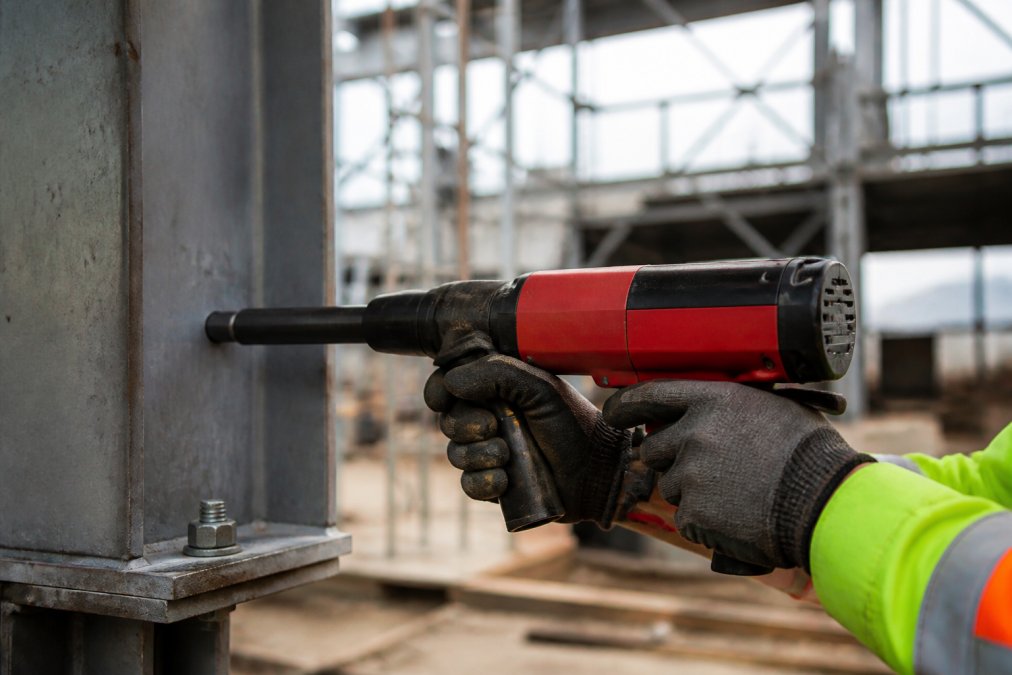
Powder-actuated fastening tools use a controlled powder charge to drive fasteners into concrete and steel without requiring external air or gas lines. A single powder load drives 8-12 fasteners, making them cost-effective for high-volume work and quieter than pneumatic alternatives. The trade-off: they deliver fixed force per shot, so material density variations can cause over- or under-driving, and setup requires more upfront calibration.
Pneumatic tools draw power from compressed air, enabling fast, consistent, adjustable fastening. They dominate production environments and are lightweight with fewer moving parts than gas-actuated tools. The downside: they require on-site compressor infrastructure, generate significant noise and vibration, and cause operator fatigue on long shifts.
Gas-actuated systems use disposable cartridges to power each fastening action, offering portability without compressor dependency, ideal for tight spaces and remote areas. The cost: every fastener requires a cartridge reload. On large projects, this adds up quickly. Gas-actuated tools also generate heat and perform poorly in cold temperatures.
| System | Power Source | Best For | Speed | Portability |
|---|---|---|---|---|
| Powder-Actuated | Powder charge | High-volume, consistent material | Moderate | High |
| Pneumatic | Compressed air | Production environments, fine control | Fast | Low |
| Gas-Actuated | Gas cartridges | Remote sites, small jobs, tight spaces | Fast | High |
In saltwater, chemical, or high-moisture environments, stainless steel strapping tools are essential, carbon steel fasteners corrode invisibly until failure. Stainless steel requires different tension curves than carbon steel and is prone to galling if tools aren’t calibrated correctly. Band-N-Go supplies stainless steel strapping tools designed for these challenges, with consistent tension delivery and precision fastening speed.
Proper stainless steel strapping tools pay for themselves in durability: systems using cheap tools need replacement every 3-5 years, while those with industrial-grade tools last 15-20 years with minimal maintenance.
Most contractors evaluate fastening tools on purchase price alone, underestimating true cost of ownership: maintenance, fastener waste, downtime, and tool replacement cycles.
A complete TCO analysis must account for five cost categories:
1. Acquisition Cost
Acquisition costs vary significantly by system type and features. This represents only a portion of total ownership expense.
2. Consumables and Cartridges
Gas-actuated systems consume one cartridge per fastener, leading to higher consumable costs on large projects. Powder-actuated systems drive multiple fasteners per charge, reducing per-fastener cost. Pneumatic systems have minimal consumable cost but require compressor fuel or electricity.
3. Maintenance and Calibration
Regular calibration is necessary; over five years, these costs can accumulate. Stainless steel strapping tools in corrosive environments need semi-annual maintenance. Pneumatic systems require air-line replacement periodically.
4. Downtime and Labor Loss
Tool failure halts work. Recalibration and major failures can lead to significant direct labor costs and schedule delays. Over five years, downtime costs can accumulate.
5. Fastener Waste and Rework
Inconsistent tool performance causes over- or under-tensioning. Inconsistent tool performance causes over- or under-tensioning, leading to wasted fasteners and replacement labor.
Real-World TCO Example:
A contractor running a large-scale marine infrastructure project over an extended period would see varying total costs depending on the fastening system chosen. In many scenarios, a pneumatic system can deliver a lower total cost of ownership (TCO) despite a higher upfront investment, due to reduced waste and downtime. However, if compressor infrastructure isn’t available, other options may prove more economical.
How to Calculate Your Own TCO:
Document project scope, request maintenance schedules from suppliers, calculate consumable costs, and add estimated downtime based on crew rates and historical failure rates.
Industrial fastening tools demand regular maintenance. Daily: inspect for loose fasteners, cracks, or bent components; clean air vents; drain water from pneumatic air lines. Lubricate moving parts with light machine oil per manufacturer specs; use corrosion-inhibiting lubricants for stainless steel strapping tools. Store in dry environments with desiccant packs to prevent corrosion. Calibrate quarterly or after major jobs to prevent drift and over-tensioning.
Industrial fastening work carries real hazards: misfires, high-pressure force, cartridge rupture. Canadian regulations require safety standards; operators need training on technique, load limits, and emergency procedures. Always wear eye and hearing protection. On high-load projects, fastener pull-out strength and load-bearing capacity are non-negotiable, undersizing or using incorrect materials causes catastrophic failure. In high-vibration environments, constant vibration loosens fasteners; industrial-grade fasteners with proper tension control and periodic inspection prevent the 50% preload loss common in mining, manufacturing, and offshore work.
Operating fastening tools for extended periods creates significant physical demands. Repetitive strain injuries (RSI), carpal tunnel syndrome, tendinitis, epicondylitis, and shoulder impingement, are common among contractors who spend 6+ hours per day driving fasteners. The cumulative effect of tool weight, vibration, grip force, and repetitive motion compounds over months and years.
Powder-actuated tools: Typically 4.5-6.5 kg, with weight distributed toward the nose (fastener-driving end). This front-heavy design requires active arm and shoulder engagement to control recoil and positioning.
Pneumatic fastening tools: Usually 2.5-4 kg, with better weight distribution. Lighter weight reduces fatigue, but higher recoil from air pressure can still create strain if the tool lacks vibration dampening.
Gas-actuated tools: Range from 2-3.5 kg, the lightest option, but single-hand operation and cartridge reloading create repetitive wrist and thumb strain.
Pneumatic systems generate 3-5 m/s² of vibration due to rapid air pressure cycles. Without vibration-dampening handles, operators on pneumatic tools experience higher HAVS risk.
Powder-actuated tools produce 2-3 m/s² of vibration, lower than pneumatic but still significant over long shifts.
Gas-actuated tools generate 1.5-2.5 m/s², the lowest vibration profile, making them the most ergonomic choice for high-volume fastening work.
Powder-actuated tools require a full-arm swing or thrust to position and fire, engaging shoulders, elbows, and wrists in a compound motion. This pattern is less repetitive but more explosive, creating higher peak loads.
Pneumatic tools enable a trigger-and-release rhythm, creating highly repetitive wrist and finger motion. Over 500-1,000 fasteners per shift, this repetition accumulates strain in the trigger finger and wrist.
Gas-actuated tools combine trigger operation with cartridge reloading, varying the motion pattern and reducing the risk of single-motion overuse.
Practical Ergonomic Strategies
Select tools matched to task duration. For jobs requiring 6+ hours of continuous fastening per day, prioritize gas-actuated or vibration-dampened pneumatic tools. For intermittent fastening, powder-actuated tools are acceptable.
Implement micro-breaks. Every 45 minutes, have operators stop fastening work for 5 minutes. Perform wrist and shoulder stretches, shake out hands, and allow blood flow to recover. This reduces cumulative strain more effectively than end-of-shift rest.
Rotate tasks and operators. Don’t assign one person to the fastening tool for an entire shift. Rotate between fastening, material handling, and inspection tasks every 2-3 hours. This distributes physical load across different muscle groups and prevents single-joint overuse.
Train on proper technique. Operator posture matters as much as tool selection. Stand with feet shoulder-width apart, keep wrists neutral (not bent), and let the tool do the work rather than forcing it. Poor posture multiplies the strain effect of tool weight and vibration.
Use personal protective equipment (PPE) designed for vibration reduction. Anti-vibration gloves reduce vibration transmission by 20-40% and provide grip support. For high-vibration tools (pneumatic systems), anti-vibration gloves are a cost-effective injury prevention measure.
Monitor for early warning signs. Tingling in fingers, persistent wrist pain, reduced grip strength, or numbness in the hand are early indicators of RSI. Address these immediately with job modification or tool change rather than pushing through, which accelerates injury.
Powder-actuated tools use a small explosive charge to drive fasteners into concrete and steel without requiring an air compressor, making them portable and ideal for remote jobsites. Pneumatic systems rely on compressed air, offering consistent power and lower operating cost per fastener but requiring compressor infrastructure. Powder-actuated delivers higher velocity and deeper penetration; pneumatic excels in repetitive applications where air supply is available. Gas-actuated tools split the difference, offering portability with consistent power for mid-range applications.
Match the strapping tool to your fastener type, load requirements, and environmental exposure. For saltwater or corrosive environments, stainless steel strapping tools prevent preload loss and corrosion that standard tools cannot withstand. Consider the fastener gauge, anchor bolt diameter, and torque requirements of your application. For pipeline and marine work, stainless steel strapping ensures long-term reliability under vibration and temperature swings. Verify that the tool’s tensioning mechanism maintains consistent tension in your specific conditions, this is critical for load-bearing capacity and safety compliance.
Clean powder-actuated tools after each use to remove residue and prevent misfires. Inspect pneumatic hoses and fittings for leaks or damage weekly. Lubricate moving parts per manufacturer specifications, inadequate lubrication is a common cause of tool failure under vibration. Check fastening tool maintenance schedules for spring replacement and seal inspection, especially in high-vibration or dusty environments. Store tools in dry conditions to prevent rust and corrosion. Regular maintenance extends tool life by 30-50% and ensures consistent fastening speed and precision.
Yes, if your projects involve structural steel, concrete anchoring, or outdoor exposure. Industrial-grade tools deliver higher fastening speed, fewer misses, and better preload consistency, reducing rework and jobsite delays. For small contractors on residential work, standard cable ties and mechanical fasteners may suffice; however, if you work in marine, mining, or heavy construction, industrial-grade stainless steel fastening tools prevent costly failures and downtime. Total cost of ownership, including tool lifespan, maintenance, and fastener waste, often favors industrial-grade tools even for smaller operations.