888-871-6573
Call Toll Free

Call Toll Free
Call Toll Free
Mining fasteners: Compare the best industrial fasteners for mining. Learn material grades, corrosion resistance, and maintenance tips to reduce downtime.
Last Updated: September 23, 2026
Mining fasteners are the threaded bolts, plow bolts, wheel studs and banding hardware that hold haul trucks, crushers, conveyors and hydraulic systems together under constant shock and vibration. Choosing them badly doesn’t just cost you a bolt. It costs you a production day.
This guide from Band-N-Go covers the fastener types, materials, torque practices and standards that keep heavy equipment running in the pit. Band-N-Go has supplied stainless banding and fastening hardware to industrial operations since 2001. The failures that stop a shift are almost never dramatic. They start as a slightly loose bolt nobody re-torqued.
Below, we break down what to specify, what to verify, and how to investigate a failure when one happens. The difference between a fastener that lasts a decade and one that lets go in a season usually comes down to four decisions made long before installation.
Match the fastener to the joint, not to whatever is in the crib. The table below maps common mining applications to the right hardware, with the grade and torque range you should expect to see on the spec sheet.
| Application | Typical Fastener | Grade / Material | Typical Torque Range (dry, zinc-plated) | Why It Fits |
|---|---|---|---|---|
| Chassis frames, structural joints | Grade 8 hex bolt | SAE J429 Grade 8 alloy steel, zinc plated | 200-300 ft-lb for 3/4″ | High tensile strength (150 ksi min), resists shock loads |
| Conveyor skirt and liner plate | Plow bolt | Grade 8 alloy or 304/316 stainless | 100-150 ft-lb for 5/8″ | Flush head, resists abrasion and snagging |
| Wheel assemblies | Wheel stud | SAE J1095 hardened alloy steel | 450-600 ft-lb for 3/4″ | Handles repeated torque cycling and clamp load |
| Hydraulic line clamps | 12-point bolt | Grade 8 alloy steel | 50-80 ft-lb for 1/2″ | Tight access, high clamp load, reduced rounding |
| Cable and hose routing | Heavy-duty cable tie | 304 or 316 stainless steel | N/A (tensioned by tool) | Vibration resistance, no creep, UV stable |
| Pipe and duct banding | Stainless steel band | 304 or 316 stainless | N/A (tensioned by tool) | Corrosion resistance, consistent tension |
Get this table wrong and no amount of maintenance will save the joint. A Grade 8 bolt in a Grade 5 application is overkill; a Grade 5 bolt in a Grade 8 application is a fatigue crack waiting to happen. The torque ranges above are starting points, always confirm against the equipment manufacturer’s specification, because joint stiffness, lubrication, and thread condition shift the torque-tension relationship by 20-30%.
Corrosion-resistant fasteners for mining are fasteners made from alloys or coatings that resist chemical attack from ore dust, acidic runoff, and washdown water. In practice, that means alloy steel with a protective coating for structural joints, and stainless steel where the fastener stays wet or exposed.
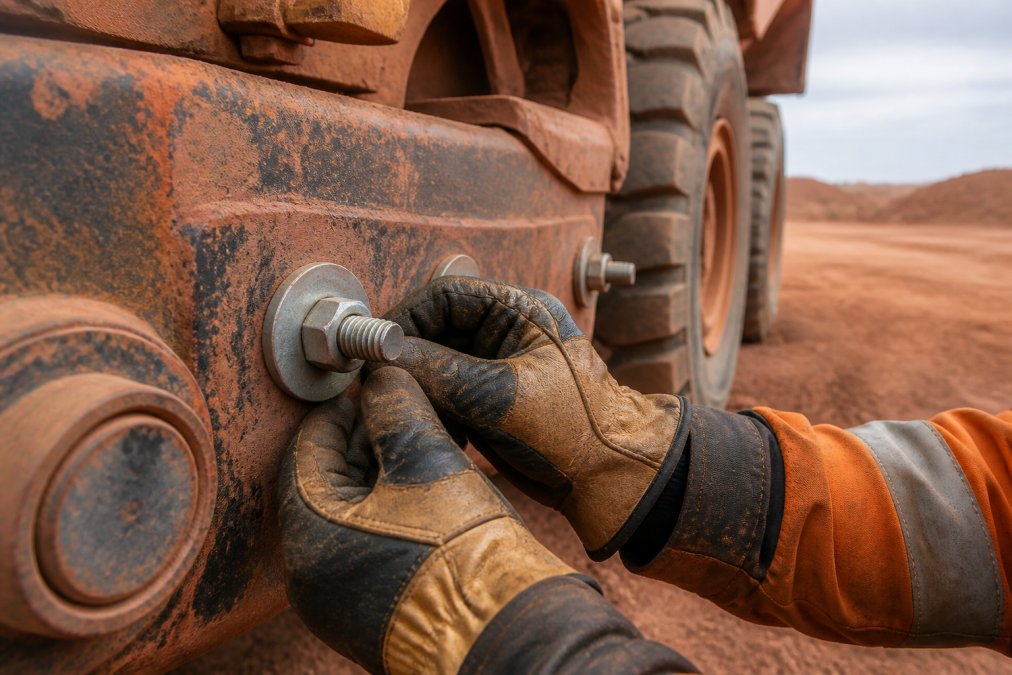
Surface treatment matters as much as the base metal. Galvanization and zinc plating both slow corrosion, but they behave differently. Zinc plating gives a thinner, more uniform coating that suits precision threads. Galvanization builds a thicker sacrificial layer better suited to outdoor structural work where a slight dimensional change is acceptable.
What most guides miss is that corrosion rarely kills a fastener outright. It reduces the cross-section, which reduces load-bearing capacity, which turns a routine shock load into a failure.
Alloy steel wins on strength per dollar. It offers the highest tensile strength of the common options and takes coatings well, which is why chassis frames and engine mounts rely on it.
Stainless steel wins on chemical resistance.
Heavy-duty cable ties for mining are stainless steel ties rated for continuous vibration and temperature swing, not nylon ties borrowed from an electrical cabinet. Nylon embrittles and creeps under UV and heat. Stainless holds.
Fastener maintenance best practices come down to three routines: verifying torque at defined intervals, inspecting for preload loss and corrosion, and replacing rather than reusing hardware that has yielded. Skipping any one of them shortens the life of the joint.
A practical inspection schedule looks like this:
The torque-tension relationship is the link between how hard you turn a bolt and how much clamping force it actually generates. You’re not tightening a bolt to a torque number. You’re stretching it so it clamps the joint.
Off-the-shelf hardware covers most joints. Custom fastening is worth the effort when the geometry, coating, or quantity doesn’t match what’s stocked, but the decision is not just about availability. It’s about total cost of ownership, lead time, and whether the custom part will actually solve the problem or just move it.
Reach for custom when:
Procurement should verify three things on every fastener order: the grade marking, the material certification, and the coating specification. If a supplier can’t produce all three, the price isn’t comparable.
Fastener failure analysis is the process of working backward from a broken or loosened fastener to its root cause. Done properly, it turns a single failure into a fix that prevents the next twenty.
Then check the joint, not just the bolt:
Mining fasteners need high tensile strength, corrosion resistance, and the ability to hold preload under constant vibration and temperature swings. Alloy steel grades like those specified in CSA standards deliver the load-bearing capacity for structural joints, while stainless steel and galvanized finishes handle wet, acidic, or salt-laden conditions. The right combination depends on whether the joint is static, like a chassis frame, or dynamic, like a crusher mount. Specify the grade and surface treatment together, not separately.
Stainless steel resists rust and chemical attack far better than plain carbon steel, which matters in mines with high humidity, acid runoff, or salt exposure. It also keeps its mechanical integrity longer, so you replace fewer fasteners during scheduled shutdowns. The trade-off is cost and, in some grades, lower tensile strength than alloy steel. For highly loaded structural joints, pair corrosion-resistant fasteners for mining with the correct grade rather than defaulting to stainless everywhere.
Constant vibration from crushers, screens, and haul trucks works fasteners loose over time. Once preload drops, the joint moves, fatigue cracks start, and failures follow. That is why mining operators see significant preload loss on untreated connections. Locking features, correct torque, and heavy-duty cable ties for mining that hold their tension all reduce this risk. Inspecting torque at set intervals catches loosening before it becomes a breakdown.
Start with the joint: load, vibration, temperature, and exposure. If a standard grade 8 bolt, plow bolt, or banding width meets the spec, off-the-shelf gets you faster delivery and lower cost. Go custom when the geometry is unusual, the coating needs to match a specific environment, or the OEM spec calls for a non-standard size. For custom orders, confirm lead times in writing before committing, since turnaround varies by supplier and quantity.