888-871-6573
Call Toll Free

Call Toll Free
Call Toll Free
Preventing preload loss in industrial fasteners: Learn how preload loss occurs in bolted joints and proven methods to prevent it.
Last Updated: October 18, 2026
Preventing preload loss in industrial fasteners is often misunderstood in its complexity. The bolt doesn’t simply “come loose”, it loses clamping force through mechanical, material, and environmental factors.
Preload is the initial tension applied during installation, creating the clamping force that holds parts together. When lost, the joint separates or shifts, causing vibration, fatigue cracking, leakage, or failure.
Embedment occurs when surfaces under the bolt head and nut compress after installation.
Tightening creates bearing stress; the material yields elastically, then plastically at contact points.
Softer metals like aluminum embed more than steel, and surface treatments, rust, paint, or contamination accelerate loss because they compress more than clean metal.
Stress relaxation is when internal bolt stress decreases over time without external loading, as the material yields under sustained tension and elevated temperature. It’s slow but relentless.
The higher the initial preload relative to yield strength, the faster relaxation occurs, a bolt at 80% of yield relaxes faster than one at 50%.
Transverse vibration is one of the most common causes of preload loss. Vibration perpendicular to the bolt axis moves clamped parts relative to each other, causing friction losses and allowing the bolt to rotate backward.
Joint separation occurs when cyclic loading pulls clamped parts apart momentarily. If large enough, the bolt loses preload and stays in the lower-tension state when the load releases. Repeated cycles compound this.
Shock loading is particularly damaging: a sudden impact or pressure spike can separate the joint significantly. If the bolt wasn’t designed for it or preload was too low, the joint fails rapidly, a regular challenge in Oil & Gas pipelines, mining equipment, and marine structures.
The best time to prevent preload loss is during installation and joint design, fixing problems later is always more expensive. These controllable factors determine whether a joint holds its preload.
Clean surfaces are non-negotiable. Dirt, grease, rust, or paint acts as a compressible layer between bolt and clamped surface.
Lubrication is where many teams make mistakes. A light machine oil or anti-seize reduces thread and under-head friction, so torque translates more directly into preload.
Excess lubrication is counterproductive, use only enough to lightly coat the threads.
Joint stiffness determines how much preload is needed to prevent separation.
Calculate required preload by analyzing joint stiffness and expected external loads, the bolt must prevent separation under worst-case load.
Clamping force is the actual bolt tension, not torque.
For critical applications, measure actual clamping force rather than relying solely on torque, ensuring every bolt achieves the intended preload.
How you tighten a bolt matters as much as how tight you make it. The method determines whether preload is consistent across all bolts in the joint and whether it remains stable over time.
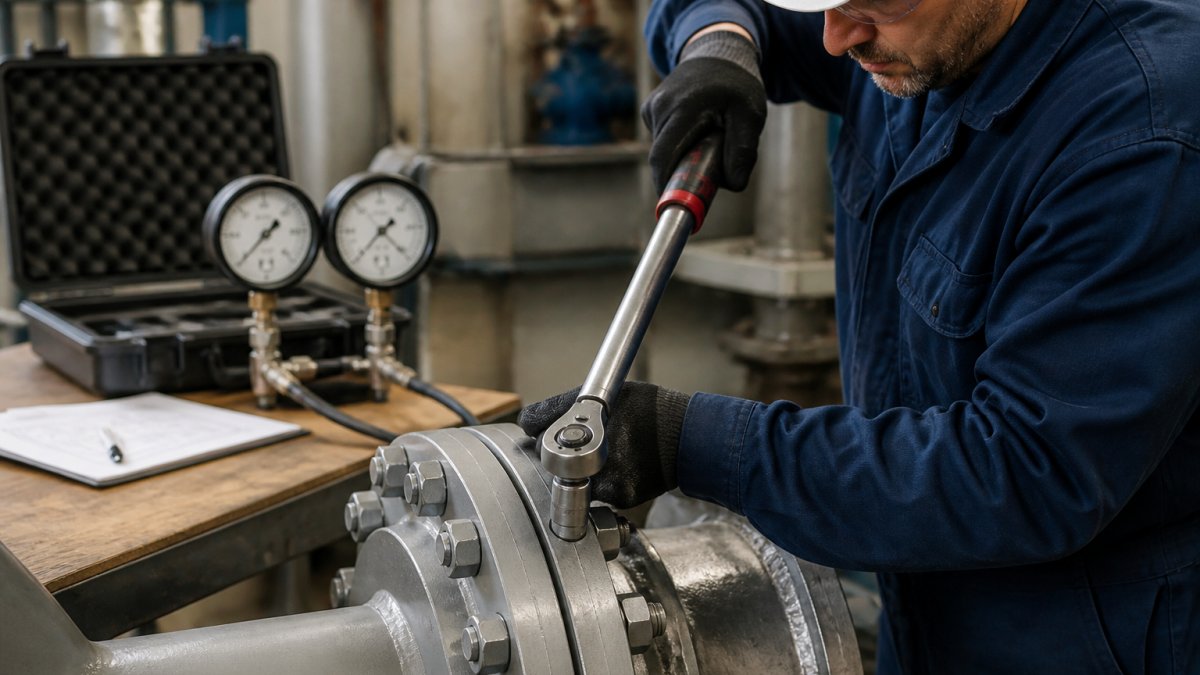
Torque-based tightening is the most common method: apply a specific torque with a calibrated wrench, which theoretically translates into clamping force.
Multiple-pass tightening improves consistency: tighten all bolts to 50% of target torque, then 75%, then 100%.
For critical joints, use a cross-pattern sequence, for eight bolts in a circle: 1, 5, 3, 7, 2, 6, 4, 8.
Angle-of-rotation (turn-of-the-nut) tightening is more accurate than torque alone: snug the bolt, then rotate an additional specific angle, often 90 or 120 degrees.
Controlled tightening combines both: tighten to moderate torque to bring the joint together, then apply additional rotation to reach target preload.
For the most demanding applications, use a tension-control (TC) bolt or calibrated fastener.
Measuring actual preload is the only way to verify the right initial tension.
Ultrasonic bolt tension measurement uses sound waves to measure elastic stretch, which correlates directly to clamping force.
Witness marks detect loosening over time: paint a line across the bolt head and clamped surface.
Verify preload immediately after installation, after the first load cycle, and at scheduled intervals.
Once correct preload is achieved, locking methods prevent the bolt from rotating backward due to vibration, cyclic loading, or other disturbances.
Spring washers (split or conical) create friction under the bolt head that resists backward rotation.
Nylon-insert locking nuts (Nyloc) have a nylon ring that grips the threads, creating friction that resists loosening.
Friction locking is passive, it makes rotation harder but doesn’t prevent it. In high-vibration or critical applications, friction locking alone is insufficient.
Mechanical locking physically prevents rotation. Common in aerospace and heavy equipment, but requires deliberate disassembly for maintenance.
Thread-locking adhesive (like Loctite) fills thread micro-gaps and hardens, creating a permanent lock.
Flange bolts with a serrated bearing surface bite into the clamped surface, resisting rotation more reliably than spring washers.
Shear pins are sacrificial fasteners that break at a specific load, preventing over-tightening and protecting the joint.
Preventing preload loss doesn’t end at installation. Regular inspection and maintenance catch problems before they cause failures.
Inspect bolted joints monthly or quarterly depending on criticality and environment.
Create witness marks across the bolt and clamped surface with a paint pen and photograph them.
For critical applications, periodically check tension with a calibrated torque wrench. If the bolt turns more than a quarter-turn with moderate force, preload is lost and it should be re-tightened.
Re-tension high-vibration equipment after the first week, then monthly for three months, then quarterly. This catches early preload loss while small; once the bolt stabilizes, extend the interval.
Monitor conditions that accelerate preload loss, temperature cycling, moisture, corrosive atmospheres, vibration.
Document all inspections and re-tensioning, and track which bolts consistently lose preload. Patterns often point to correctable design, installation, or environmental issues.
Different industries face unique challenges to preventing preload loss, which shape the right fasteners, locking methods, and maintenance protocols.
Pipeline flanges experience constant pressure cycling as flow rates change, stressing bolts and causing joint separation and preload loss.
Use heavy-duty locking, thread-locking adhesive or mechanical locking like castle nuts; friction locking alone is insufficient.
Thermal cycling from ambient or process fluid temperature changes makes bolt and clamped parts expand and contract at different rates, stressing the joint.
Saltwater corrosion is relentless: standard steel fasteners corrode rapidly and lose strength. 316 stainless resists it far better, though not immune, and duplex stainless offers even higher resistance for demanding marine applications.
Galvanic corrosion occurs when dissimilar metals contact in a corrosive environment, a stainless bolt with a steel nut in saltwater corrodes the steel rapidly.
Apply corrosion-inhibiting coating or grease to all marine fasteners, reapplying periodically. For permanent installations, encapsulate with sealant to keep moisture out.
Mining equipment operates across extreme temperature ranges and experiences shock loads from impacts and vibration, accelerating preload loss through thermal cycling and cyclic plasticity.
Use high-strength alloy steel fasteners that resist cyclic plasticity better than standard steel.
Inspect mining equipment joints monthly or after any major shock event. Daily temperature swings cause normal fluctuation, but a trend of decreasing preload over weeks or months signals a problem requiring intervention.
Acceptable preload loss depends on quantifying the loss against the joint’s design margin.
Design limits are typically 50-70% of yield strength for static loads and 30-40% for cyclic or shock loads.
Preventing preload loss in industrial fasteners requires the right controls: proper installation, clean surfaces, correct lubrication, and controlled tightening.
Preload loss occurs through four primary mechanisms: embedment (when rough surfaces compress under clamping force), stress relaxation (material deformation over time), cyclic plasticity (plastic deformation from repeated loading), and joint separation under vibration or thermal cycling. In industrial applications, embedment often accounts for 10-20% of initial preload loss within the first few hours of operation. Identifying which mechanism dominates your application determines the most effective prevention strategy.
Use a combination of three strategies: (1) apply proper preload using controlled tightening methods to keep clamping force above the separation threshold, (2) install locking devices such as spring washers, locking nuts, or thread-locking adhesive to resist rotation loosening, and (3) minimize transverse vibration amplitude through joint stiffness optimization and damping. For high-vibration environments like oil and gas pipelines, multiple-pass tightening sequences and mechanical locking methods provide the most reliable protection against fastener failure.
Three primary methods exist: ultrasonic measurement (non-destructive, measures bolt elongation to calculate tension), strain gauges (embedded in the bolt to monitor stress directly), and load cells (placed under the bolt head to measure clamping force during installation). For field inspection of existing joints, visual rotation detection and torque re-checking with a calibrated wrench provide quick verification. Ultrasonic methods are most practical for production environments and require minimal disassembly, making them ideal for scheduled maintenance on critical infrastructure.
Spring washers and other friction locking devices reduce rotation loosening by increasing friction at the bearing surface, but they do not prevent preload loss from embedment, stress relaxation, or cyclic plasticity. They work best when combined with proper torque application and regular inspection. For extreme conditions like marine saltwater exposure or mining vibration, mechanical locking methods (such as locking nuts with nylon inserts) or permanent solutions (thread-locking adhesive) provide superior performance. The choice depends on whether your joint experiences rotation loosening, preload loss, or both.
Inspection frequency depends on operating conditions. High-vibration environments (oil and gas, mining) require inspection every 1-3 months initially, then quarterly after stabilization. Thermal cycling applications (outdoor HVAC, utility infrastructure) need seasonal checks. Marine saltwater installations should be inspected every 2-3 months due to corrosion acceleration. Establish a baseline inspection 24-48 hours after installation to measure initial embedment loss, then adjust the schedule based on observed preload loss rates. Document findings to predict failure patterns and optimize maintenance intervals.
Yes. Thermal cycling causes differential expansion and contraction between the bolt, clamped materials, and surrounding structure. Temperature swings create stress redistribution that reduces clamping force, and repeated cycling accelerates stress relaxation in the bolt material. In mining operations and outdoor utility installations, temperature swings of 40-60°C can cause 15-25% additional preload loss beyond mechanical sources. Use fasteners with matching thermal expansion coefficients to the clamped materials, and design joints with sufficient preload margin to accommodate thermal effects. Stainless steel fasteners perform better than carbon steel in cycling environments due to superior stress relaxation resistance.
Bolt preload is the tensile force applied to the bolt during tightening, measured in newtons or pounds. Clamping force (clamp load) is the compressive force holding the joint together, which equals the preload minus any external load. When external shear force or vibration causes joint separation, clamping force decreases faster than preload. Understanding this distinction is critical: a joint may retain 80% of its preload but lose 50% of its clamping force if external loading increases. Proper joint design ensures sufficient preload margin so that clamping force never reaches zero, preventing rotation loosening and fastener failure.
Use a cross pattern (alternating opposite bolts) or radial sequence (working outward from center) to distribute clamping force evenly and minimize joint bending. For critical applications, apply a multiple-pass tightening sequence: first pass to 25-30% of final torque, second pass to 60-70%, final pass to 100%. This gradual approach reduces embedment loss and allows surface irregularities to settle. Allow 15-30 minutes between passes for stress redistribution. For flanged bolted joints in oil and gas pipelines, follow the specific cross pattern recommended by the flange standard (ASME B16.5) to ensure consistent preload and prevent leakage or fastener failure.